
Description
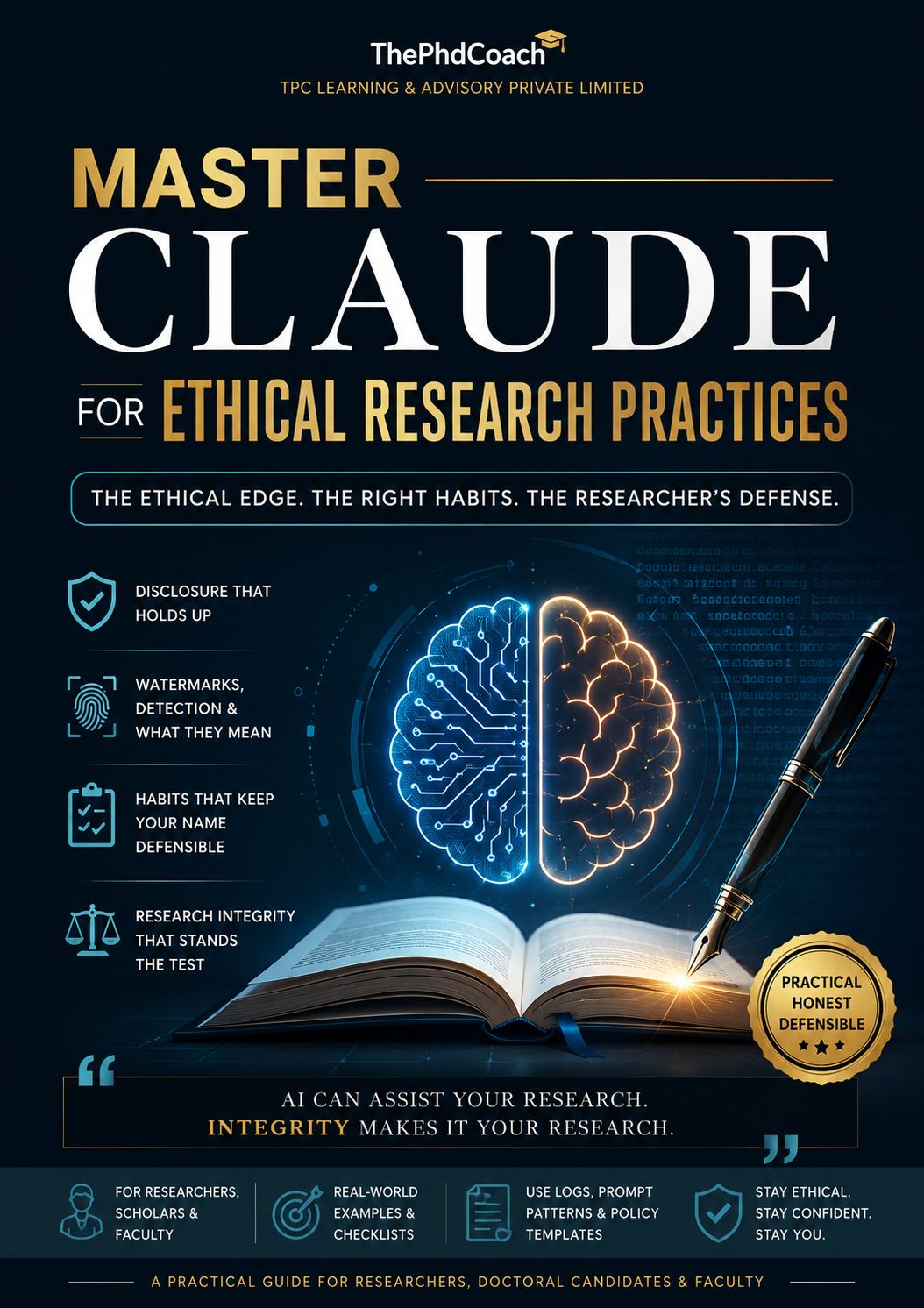
Master Claude for Ethical Research Practices is a practical guide for researchers who want to use Claude and other AI tools intelligently, ethically, and confidently—without compromising research integrity. Learn how to use AI responsibly, verify outputs, disclose AI use appropriately, understand watermarks and AI detection, protect confidential data, and remain fully accountable for every piece of research carrying your name.
Description
AI is changing the way researchers write, analyse, learn, and conduct research. But with this opportunity comes an important question: How do you use AI without compromising the integrity and ownership of your work?
Master Claude for Ethical Research Practices is a practical guide designed to help researchers navigate this evolving landscape with clarity and confidence.
This is not a guide to avoiding AI detection or hiding AI use. Instead, it helps you build research practices that you can confidently defend. You will learn where the ethical boundaries lie, how to verify AI-generated information, when and how to disclose AI use, what AI watermarks and detection tools can—and cannot—tell you, and how to maintain evidence of your research process.
Because at the end of the day, AI can assist you—but the work, the responsibility, and the researcher’s name are still yours.
What’s Included
- A practical guide to using Claude ethically in research
- Clear guidance on AI disclosure and accountability
- Understanding AI watermarks and what they actually mean
- A critical look at AI detection and its limitations
- A task-by-task permission map for AI use in research
- Citation verification and fact-checking practices
- Guidance on protecting confidential and sensitive research material
- Practical disclosure templates
- AI use log guidance
- Pre-submission checklist
- Prompt patterns that help reduce research risks
- Guidance for researchers, doctoral candidates, supervisors, and faculty
Why Researchers Love This Vault
Researchers are overwhelmed by conflicting advice about AI: Can I use it? How much can I use? Do I need to disclose it? What if my work gets flagged?
This guide cuts through the confusion.
Instead of vague advice like “use AI responsibly,” you get practical frameworks, real-world scenarios, checklists, and actionable guidance to help you make better decisions at every stage of your research journey.
The focus is simple: Use AI as an assistant without outsourcing your thinking, judgement, accountability, or academic integrity.
Who Is This For?
This guide is designed for:
- PhD scholars and doctoral candidates
- Master’s and postgraduate students
- Faculty members and professors
- Independent researchers
- Academic writers
- Research supervisors and mentors
- Anyone using Claude or other generative AI tools in their research
Whether you are just beginning to explore AI or already using it extensively, this guide will help you create a safer, more ethical, and more defensible research workflow.
What You’ll Learn Inside
Inside this guide, you will learn:
- What you are actually accountable for as a researcher
- Why AI can assist your writing but cannot take responsibility for your research
- The difference between legitimate AI assistance and over-reliance
- How to verify AI-generated claims, citations, and references
- When AI use may need to be disclosed
- How AI watermarks work and what they can and cannot prove
- Why AI detector scores should not be treated as proof of authorship
- How to protect confidential research data and unpublished material
- How to maintain a record of your AI-assisted research process
- What evidence can help you defend your authorship and research process
- How to build habits that make your research ethically stronger and easier to defend
Important Note
This guide is designed to support ethical, transparent, and responsible AI use in research. It does not promote methods for bypassing AI detection, hiding AI use, fabricating references, or avoiding institutional and journal requirements.
AI policies, publisher guidelines, institutional regulations, and technical developments continue to evolve. Always check the latest requirements of your university, institution, supervisor, ethics committee, and target journal before submitting your work.
Remember: AI can assist your research. But integrity is what keeps the work yours.



Reviews
There are no reviews yet.